5.1 - Recover Recycle and Reclaim
Module: Recovery Recycling Reclaiming Evacuation and Dehydration
Regulatory verification date: August 9, 2026
Primary authority: 40 CFR Part 82, Subpart F and current EPA Section 608 refrigerant-reclamation guidance
Course role: Establishes the regulatory and technical distinction among recovering, recycling, and reclaiming refrigerant before later sections develop recovery equipment, procedures, cylinders, and evacuation requirements
Learning Objectives
After completing this section, a student should be able to:
- Define recover, recycle, and reclaim using the current Section 608 meanings.
- Distinguish the amount of processing and verification associated with recovered, recycled, and reclaimed refrigerant.
- Explain the Section 608 purity requirement for reclaimed refrigerant and the role of Appendix A to 40 CFR Part 82, Subpart F and AHRI Standard 700.
- Determine when recovered or recycled refrigerant may be reused without reclamation because the refrigerant remains under the same ownership.
- Explain why used refrigerant generally must be reclaimed by an EPA-certified reclaimer before it is sold or otherwise transferred to a new owner for use as refrigerant.
- Apply the three terms correctly to representative service and refrigerant-management situations.
Introduction
A technician removing refrigerant from an appliance may perform several very different actions with that refrigerant.
The refrigerant may be:
- Removed and stored.
- Cleaned for reuse.
- Processed and laboratory-verified to a specified purity.
These actions are not interchangeable.
Section 608 uses three specific terms:
Recover
Recycle
Reclaim
A common examination mistake is to treat them as three names for the same process.
They are not.
The simplest way to remember the progression is:
RECOVER
Remove and store

RECYCLE
Remove and clean for same-owner reuse

RECLAIM
Reprocess and verify to required purity
The distinction matters because it affects:
- What processing has occurred.
- Whether purity has been verified.
- Who may perform the process.
- Whether the refrigerant can be transferred to another owner for use as refrigerant.
- Whether the refrigerant may be reused within equipment owned by the same person.
This section establishes these concepts before later Module 5 sections address the equipment and procedures used to remove refrigerant from appliances.
Key Concepts
1. Recover Means Remove and Store
To recover refrigerant means to remove refrigerant in any condition from an appliance and store it in an external container without necessarily testing or processing it.
The essential idea is:
Appliance
→ refrigerant removed
→ external container
Recovery does not by itself mean that the refrigerant has been:
- Cleaned.
- Filtered.
- Dried.
- Tested for purity.
- Restored to an industry purity specification.
- Reclaimed.
A technician may recover refrigerant because the appliance must be:
- Serviced.
- Repaired.
- Opened.
- Retired.
- Disposed of.
- Converted to another refrigerant.
- Temporarily emptied for another permitted purpose.
The recovery process captures the refrigerant so that it is not intentionally released to the atmosphere during covered work.
2. Recycle Means Remove and Clean for Same-Owner Reuse
Under the Section 608 definition for stationary appliances, to recycle refrigerant means to extract refrigerant from an appliance and clean it for reuse in equipment of the same owner without meeting all of the requirements for reclamation.
Typical recycling processes may include:
- Oil separation.
- One or more passes through filter-driers.
- Reduction of moisture.
- Reduction of acidity.
- Reduction of particulate matter.
The key concept is:
Recovered refrigerant
+
cleaning
→ recycled refrigerant
Recycling improves the condition of the refrigerant, but it does not automatically establish that the refrigerant meets every purity specification required for reclaimed refrigerant.
Therefore:
Recycled refrigerant is not the same as reclaimed refrigerant.
For Section 608 stationary-appliance work, the recycling definition is tied to reuse in equipment owned by the same person.
The Section 608 definition discussed in this section excludes motor-vehicle air conditioners. MVAC recycling is addressed under the Section 609 framework.
3. Reclaim Means Reprocess and Verify Purity
To reclaim refrigerant means to reprocess recovered refrigerant so that it meets all applicable refrigerant-purity specifications required by the current Section 608 rule and to verify compliance using the prescribed analytical methodology.
The basic sequence is:
Used refrigerant
→ specialized reprocessing
→ analytical verification
→ required purity achieved
→ reclaimed refrigerant
Reclamation is more than:
- Recovering.
- Filtering.
- Removing oil.
- Passing refrigerant through a field filter-drier.
- Checking refrigerant identity with a field identifier.
Reclamation requires both:
Reprocessing
+
verification
The verification step is essential.
A refrigerant is not considered reclaimed merely because it appears clean or because a technician believes the refrigerant is suitable for use.
4. Reclamation Is Performed by an EPA-Certified Reclaimer
Used refrigerant that must be reclaimed for transfer to a new owner is processed by an EPA-certified refrigerant reclaimer.
A normal field technician does not become a refrigerant reclaimer merely by owning:
- A recovery machine.
- A recycling machine.
- A filter-drier.
- A vacuum pump.
- A refrigerant identifier.
- A recovery cylinder.
Field recovery equipment and reclamation equipment serve different purposes.
A technician generally:
recovers refrigerant
→ stores it properly
→ returns it for reclamation when required
The refrigerant may be sent:
- Directly to an EPA-certified reclaimer.
- To a refrigerant manufacturer that performs or arranges reclamation.
- Through a consolidator, distributor, supplier, or recovery company that prepares it for reclamation.
5. Ownership Is a Critical Distinction
For Section 608 stationary-appliance refrigerant management, one of the most important questions is:
Does the refrigerant remain with the same owner, or will it be transferred to a new owner for use as refrigerant?
This creates two important pathways.
Same Owner
Recovered and/or recycled refrigerant may be returned to:
- The same appliance.
- Another appliance owned by the same person.
It does not have to be reclaimed merely because it is moved from one appliance to another appliance owned by that same person.
However, the absence of a reclamation requirement does not mean that every reuse decision is technically appropriate.
The technician must still consider:
- Correct refrigerant identity.
- Refrigerant condition.
- Contamination.
- Mixed refrigerants.
- Moisture.
- Acid.
- Oil contamination.
- Equipment compatibility.
- Manufacturer instructions.
- Applicable safety requirements.
New Owner
If used refrigerant changes ownership for use as refrigerant, it generally must first be reclaimed by an EPA-certified reclaimer.
The high-priority rule is:
Same owner
→ reclamation not automatically required

New owner
→ used refrigerant generally must be reclaimed
This ownership rule is especially important for examination questions.
6. Selling Used Refrigerant Is Not the Same as Returning It for Reclamation
A technician may have recovered refrigerant that is no longer needed by the owner.
That refrigerant should not simply be sold as usable refrigerant to another equipment owner.
Instead, it may be sent into the reclamation chain.
For example:
Technician
→ used refrigerant
→ distributor / consolidator / EPA-certified reclaimer
→ reclamation
→ verified reclaimed refrigerant
→ lawful resale for use
A reclaimer or a distributor working with reclaimers may provide compensation for returned used refrigerant depending on:
- Refrigerant type.
- Quantity.
- Purity.
- Degree of contamination.
- Market conditions.
Receiving compensation for material sent into an authorized reclamation process is different from selling unreclaimed used refrigerant to a new appliance owner for direct use.
7. Recovery Does Not Establish Refrigerant Quality
Suppose refrigerant is removed from a system and placed into a recovery cylinder.
At that point, the technician knows that the refrigerant has been recovered.
The technician does not automatically know that it is:
- Pure.
- Dry.
- Acid-free.
- Free of air.
- Free of other refrigerants.
- Suitable for installation into another system.
The refrigerant may contain:
- Lubricant.
- Moisture.
- Acid.
- Particulate matter.
- Noncondensables.
- Another refrigerant.
- Decomposition products.
Therefore:
Recovery describes removal and storage, not purity.
8. Recycling Does Not Equal Full Purity Verification
Recycling can improve refrigerant condition by removing or reducing contaminants.
However, recycling does not require the complete processing and analytical verification associated with reclamation.
A field recycling process may reduce:
Oil
Moisture
Acidity
Particles
but this does not mean that the refrigerant has been verified against every applicable reclamation specification.
Therefore:
Recycled
≠
Reclaimed
9. Reclaimed Does Not Mean Virgin
Virgin refrigerant is newly manufactured refrigerant that has not previously been used in an appliance.
Reclaimed refrigerant has been recovered after use, reprocessed, and verified to meet the applicable purity specifications.
These are different source histories.
The important point is that reclaimed refrigerant has been processed and verified to an established purity standard suitable for its regulated resale and reuse.
Do not interpret the term reclaimed as meaning:
newly manufactured
Instead, remember:
Virgin
→ new material

Reclaimed
→ used material restored and verified to required purity
Technical and Regulatory Details
1. Current Section 608 Definitions
The three definitions can be compared directly.
| Term | Section 608 Meaning | Cleaning Required? | Full Reclamation Purity Verification? | Typical Outcome |
|---|---|---|---|---|
| Recover | Remove refrigerant from an appliance and store it in an external container | No | No | Refrigerant is captured for later handling |
| Recycle | Extract and clean refrigerant for reuse in equipment of the same owner without meeting all reclamation requirements | Yes | No | Refrigerant is cleaned for permitted same-owner reuse |
| Reclaim | Reprocess recovered refrigerant to all applicable required purity specifications and verify those specifications analytically | Yes, to required specification | Yes | Refrigerant is restored and verified for regulated resale / transfer |
The easiest distinction is:
Recover
→ REMOVE

Recycle
→ CLEAN

Reclaim
→ PURIFY + VERIFY
2. Current Federal Reclamation Purity Standard
The current Section 608 regulatory definition of reclaim points to:
Appendix A to 40 CFR Part 82, Subpart F
Appendix A is based on:
AHRI Standard 700-2016
Specifications for Refrigerants
The federal requirement is not simply:
"make the refrigerant look clean"
The refrigerant must meet the applicable specifications and its compliance must be verified using the prescribed analytical methodology.
The specifications address refrigerant quality characteristics and contaminants appropriate to the refrigerant.
At an exam-preparation level, remember:
Reclamation requires verified compliance with the applicable purity specifications; recycling does not.
3. Regulatory Edition Versus Current Industry Edition
AHRI has published newer editions of Standard 700, including AHRI 700-2024.
However, the current Section 608 regulation continues to define reclaim through Appendix A to Subpart F, which is based on AHRI Standard 700-2016.
This distinction matters:
| Context | Reference |
|---|---|
| Current Section 608 legal definition of reclaim | Appendix A to 40 CFR Part 82, Subpart F, based on AHRI 700-2016 |
| Current AHRI-published industry standard available from AHRI | AHRI 700-2024 |
Do not automatically replace the edition incorporated into a federal rule with a newer industry edition when answering a regulatory question.
For an EPA 608 question asking what the current federal definition requires, follow the current regulation.
4. What AHRI Standard 700 Does
AHRI Standard 700 establishes:
- Refrigerant purity specifications.
- Acceptable contaminant limits.
- Test methods used to evaluate refrigerant acceptability.
The standard applies to refrigerants regardless of whether the material is:
- Newly manufactured.
- Reclaimed.
- Repackaged.
Its function is to provide objective specifications and test methods rather than relying on appearance or field judgment alone.
5. Reclamation Includes Verification
A common examination trap is:
Refrigerant is filtered repeatedly
→ therefore it is reclaimed
This is incorrect.
The full concept is:
Reprocess to required specifications
+
verify the specifications with prescribed analytical methods
=
reclaim
Filtering by itself is not enough.
6. Same-Owner Reuse
Recovered and/or recycled refrigerant can be returned to:
same system
or:
another system owned by the same person
without the Section 608 reclamation requirement being triggered solely by that reuse.
For example:
Owner A - Rooftop Unit 1
→ refrigerant recovered
→ appropriately managed
→ Owner A - Rooftop Unit 2
Reclamation is not automatically required merely because the refrigerant moved from Unit 1 to Unit 2.
The important condition is:
same owner
This does not remove the technician’s responsibility to ensure that reuse is technically appropriate.
7. Transfer to a New Owner
Now consider:
Owner A - Appliance
→ refrigerant recovered
→ Owner B - Appliance
If the used refrigerant is being transferred to the new owner for use as refrigerant, the Section 608 reclamation requirement applies.
The correct pathway is:
Recovered used refrigerant
→ EPA-certified reclaimer
→ required purity verified
→ reclaimed refrigerant
→ resale / transfer to new owner
The ownership change is the key condition.
8. Same Customer Is the Same-Owner Concept
A technician or service company may be physically handling refrigerant that belongs to a customer.
For example, a contractor may recover refrigerant from one appliance owned by Customer A and later use that refrigerant in another suitable appliance also owned by Customer A.
The technician’s possession of the cylinder during service does not by itself mean that the refrigerant has been sold to the technician as a new appliance owner.
For examination purposes, focus on the ownership of the refrigerant / appliance relationship, not merely who is temporarily holding the recovery cylinder.
9. Reuse Does Not Override Contamination Concerns
The same-owner rule concerns whether reclamation is required before reuse or ownership transfer.
It does not guarantee that the refrigerant is suitable for reuse.
Do not reuse refrigerant merely because:
same owner
if the refrigerant is suspected to be:
- Mixed with another refrigerant.
- Severely contaminated.
- Chemically degraded.
- Incompatible with the receiving appliance.
- Otherwise unsuitable under the applicable service procedure.
A technician must keep the legal ownership rule separate from the technical suitability decision.
10. Do Not Mix Different Refrigerants
Recovery and recycling depend on maintaining refrigerant identity.
Mixing different refrigerants can:
- Make the material difficult or expensive to reclaim.
- Make it unsuitable for direct reuse.
- Contaminate recovery equipment.
- Contaminate recovery cylinders.
- Create incorrect pressure-temperature behavior.
- Create safety and equipment-compatibility problems.
Therefore:
Identify refrigerant
→ keep refrigerants separated
→ label recovered material correctly
Detailed recovery preparation is developed in Section 5.4 - Recovery Preparation.
11. Recovering Is Not Evacuating
Another common terminology error is to treat recovery and evacuation as the same process.
They are different.
Recovery removes refrigerant from an appliance for storage and management.
Evacuation uses a vacuum pump to remove air, water vapor, and other gases after refrigerant has been properly removed to the required level.
Do not use a vacuum pump as a substitute for a recovery machine.
Evacuation and dehydration are developed in Section 5.7 - Evacuation and Dehydration.
The Three Processes Compared
Recover
Starting point:
Refrigerant is inside an appliance

Process:
Remove refrigerant

Destination:
External recovery container

Purity verification:
Not required by the definition

Primary idea:
CAPTURE
Recycle
Starting point:
Recovered refrigerant

Process:
Clean refrigerant
Examples: oil separation and filtration

Destination:
Permitted reuse in equipment of the same owner

Full reclamation purity verification:
No

Primary idea:
CLEAN
Reclaim
Starting point:
Recovered used refrigerant

Process:
Specialized reprocessing

Verification:
Analytical testing against applicable purity specifications

Performed through:
EPA-certified refrigerant reclaimer

Primary idea:
RESTORE + VERIFY
Ownership Decision Process
Use the following sequence when deciding whether reclamation is required before reuse or transfer.
Step 1 - Is the Refrigerant Used?
If the refrigerant has been recovered from an appliance, treat it as used refrigerant rather than virgin refrigerant.
Step 2 - Will It Stay With the Same Owner?
If yes, it may be returned to:
- The same appliance.
- Another suitable appliance owned by that same person.
Section 608 does not require reclamation solely because of this same-owner reuse.
Step 3 - Will It Change Ownership for Use as Refrigerant?
If yes:
Used refrigerant
→ reclaim before resale / transfer for use
The reclamation must be performed by an EPA-certified refrigerant reclaimer.
Step 4 - Is the Refrigerant Technically Suitable for Reuse?
Even when reclamation is not required, verify:
- Refrigerant identity.
- Compatibility.
- Contamination condition.
- Appropriate service procedure.
- Equipment-manufacturer requirements.
Step 5 - Keep Refrigerant Streams Separated
Do not intentionally mix different refrigerants into the same recovery cylinder unless the material is being handled under an appropriate contaminated-refrigerant process and the receiving facility accepts it.
Representative Scenarios
| Scenario | Correct Classification or Action |
|---|---|
| Refrigerant is removed from a split system and placed in a recovery cylinder | Recovered |
| Recovered refrigerant is passed through oil separation and filter-driers for reuse in another appliance of the same owner | Recycled |
| Used refrigerant is reprocessed and analytically verified to the applicable required purity specifications | Reclaimed |
| Recovered refrigerant is returned to the same appliance after a repair | Reclamation is not required solely because the refrigerant was recovered |
| Recovered refrigerant from one appliance is used in another suitable appliance owned by the same owner | Reclamation is not required solely because the refrigerant moved between the owner’s appliances |
| Technician wants to sell recovered used refrigerant directly to an unrelated equipment owner for use | Do not do so; the used refrigerant must first be reclaimed through an EPA-certified reclaimer |
| Recovered refrigerant is filtered in the field but receives no full analytical purity verification | It may be recycled, but it is not thereby reclaimed |
| A refrigerant identifier indicates that a cylinder appears to contain one refrigerant | Identification alone does not establish reclamation purity |
| Used refrigerant is sent to a distributor or consolidator for eventual reclamation | Appropriate pathway toward reclamation; the intermediary is not automatically the final reclaimer |
| Recovered refrigerant is suspected to contain multiple refrigerants | Keep it segregated and follow the receiving facility’s contaminated-refrigerant procedure rather than treating it as clean reusable refrigerant |
Important Terms
AHRI Standard 700
AHRI Standard 700 — Specifications for Refrigerants establishes refrigerant purity specifications and associated test methods.
For the current Section 608 legal definition of reclaim, use the specifications in Appendix A to 40 CFR Part 82, Subpart F, which is based on AHRI Standard 700-2016.
EPA-Certified Refrigerant Reclaimer
An EPA-certified refrigerant reclaimer is an organization certified by EPA to reprocess used refrigerant and verify that applicable reclamation requirements are satisfied before the refrigerant is sold for use to a new owner.
Reclaim
To reclaim means to reprocess recovered refrigerant to the applicable purity specifications required by Appendix A to 40 CFR Part 82, Subpart F and verify compliance using the prescribed analytical methodology.
Recover
To recover means to remove refrigerant in any condition from an appliance and store it in an external container without necessarily testing or processing it.
Recycle
For Section 608 stationary-appliance refrigerant, to recycle means to extract refrigerant from an appliance and clean it for reuse in equipment of the same owner without satisfying all reclamation requirements.
Recovered Refrigerant
Recovered refrigerant is refrigerant removed from an appliance and stored externally. Recovery by itself does not establish purity.
Recycled Refrigerant
Recycled refrigerant is refrigerant that has been extracted and cleaned for permitted same-owner reuse without full reclamation processing and verification.
Reclaimed Refrigerant
Reclaimed refrigerant is used refrigerant that has been reprocessed and analytically verified to meet the applicable purity specifications required for reclamation.
Same-Owner Reuse
Same-owner reuse is reuse of recovered or recycled refrigerant in the same appliance or another suitable appliance owned by the same person without triggering the reclamation requirement solely because of that reuse.
Used Refrigerant
Used refrigerant is refrigerant that has previously been used in an appliance and has been recovered for reuse, recycling, reclamation, destruction, or another appropriate management pathway.
Virgin Refrigerant
Virgin refrigerant is newly manufactured refrigerant that has not previously been used in an appliance.
Figures and Diagrams
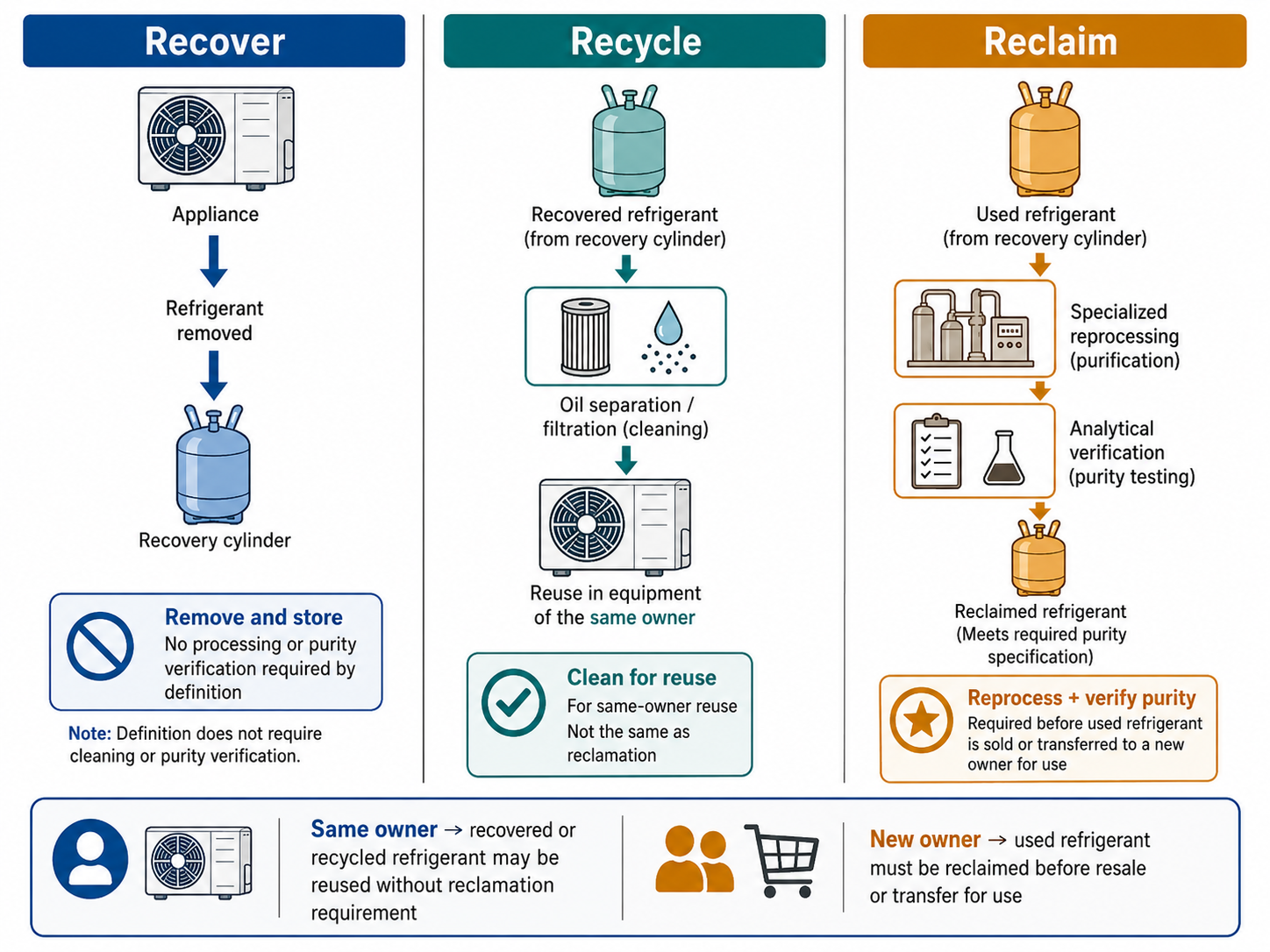
Figure 5.1.1 – Comparison of recovering, recycling, and reclaiming refrigerant.
AI-generated instructional figure: It may contain visual inaccuracies. Use the accompanying lesson text and cited authoritative sources to verify technical and regulatory details.
EPA 608 Exam Focus
What Students Must Remember
- Recover = remove and store.
- Recovery does not automatically clean or test refrigerant.
- Recycle = extract and clean for same-owner reuse without meeting all reclamation requirements.
- Recycling commonly uses oil separation and filtration to reduce contaminants.
- Recycled refrigerant is not automatically reclaimed.
- Reclaim = reprocess to the applicable required purity specifications and verify the purity analytically.
- Reclamation for Section 608 is performed through an EPA-certified refrigerant reclaimer.
- Current Section 608 reclamation requirements point to Appendix A to 40 CFR Part 82, Subpart F, based on AHRI Standard 700-2016.
- AHRI publishes newer editions of Standard 700, but do not substitute a newer industry edition for the edition incorporated into the current federal rule when answering a Section 608 regulatory question.
- Recovered and/or recycled refrigerant may be returned to the same appliance or another suitable appliance owned by the same person without reclamation being required solely because of that reuse.
- Used refrigerant generally must be reclaimed before it is sold or transferred to a new owner for use as refrigerant.
- The ownership rule and the technical suitability of refrigerant are separate questions.
- Same-owner reuse does not make contaminated or mixed refrigerant acceptable.
- A field refrigerant identifier does not establish that refrigerant has met reclamation purity requirements.
- Virgin and reclaimed refrigerant are not the same source category.
- Section 608’s recycling definition discussed here excludes MVACs; Section 609 has separate recycling provisions.
Three-Word Memory Aid
RECOVER → REMOVE
RECYCLE → CLEAN
RECLAIM → VERIFY
A more complete version is:
Recover
→ Remove + Store

Recycle
→ Remove + Clean
→ Same Owner

Reclaim
→ Reprocess + Verify
→ New-Owner Resale / Transfer
Typical Exam Question Patterns
Students may be asked to:
- Identify which term means removal and storage.
- Identify which term includes cleaning for same-owner reuse.
- Identify which term requires verified purity.
- Distinguish recycling from reclamation.
- Determine whether recovered refrigerant may be returned to the same appliance.
- Determine whether refrigerant recovered from one appliance may be used in another appliance with the same owner.
- Determine what must occur before used refrigerant is sold for use to a different owner.
- Identify who performs regulated reclamation.
- Recognize the role of Appendix A and AHRI Standard 700.
- Distinguish the federal incorporated AHRI 700-2016 basis from a newer industry edition.
- Identify why field filtration does not by itself constitute reclamation.
- Recognize that refrigerant identification is not the same as purity verification.
High-Priority Comparison Table
| Exam Clue | Most Likely Answer |
|---|---|
| Remove refrigerant and place it in an external container | Recover |
| No testing or processing necessarily performed | Recover |
| Oil separation and filter-drier cleaning | Recycle |
| Cleaned for reuse in equipment of the same owner | Recycle |
| Full applicable purity specifications and analytical verification | Reclaim |
| EPA-certified refrigerant reclaimer | Reclaim |
| Same appliance, same owner | Reclamation not required solely for that reuse |
| Different appliance, same owner | Reclamation not required solely for that reuse |
| Used refrigerant transferred to a new owner for use | Reclamation required |
| Field filtering only | Not enough to call the refrigerant reclaimed |
| Refrigerant identifier only | Does not prove reclamation purity |
| New refrigerant never previously used | Virgin |
| Used refrigerant restored and verified to required purity | Reclaimed |
Common Mistakes and Confusing Points
Mistake 1: Treating Recover Recycle and Reclaim as Synonyms
Correct distinction:
Recover → remove and store
Recycle → clean for same-owner reuse
Reclaim → reprocess and verify required purity
Mistake 2: Assuming Recovered Refrigerant Is Clean
Recovery describes removal and storage.
It does not establish refrigerant purity.
Mistake 3: Assuming Filtering Means Reclamation
Filtering can be part of recycling.
Reclamation requires the applicable purity specifications and analytical verification.
Mistake 4: Assuming a Field Technician With a Recovery Machine Is a Reclaimer
A recovery machine removes refrigerant.
EPA-certified reclamation is a different regulated activity.
Mistake 5: Assuming Used Refrigerant Must Always Be Reclaimed Before Any Reuse
Recovered and/or recycled refrigerant may be reused in the same system or another suitable system owned by the same person without reclamation being required solely because of the reuse.
Mistake 6: Assuming Same-Owner Reuse Means the Refrigerant Is Automatically Suitable
Ownership determines whether the reclamation requirement is triggered.
Technical suitability still depends on identity, cleanliness, compatibility, and system condition.
Mistake 7: Selling Unreclaimed Used Refrigerant Directly to a New Owner
Used refrigerant generally must be reclaimed by an EPA-certified reclaimer before resale or transfer to a new owner for use as refrigerant.
Mistake 8: Confusing AHRI’s Current Industry Edition With the Edition Incorporated Into the Section 608 Rule
AHRI currently publishes AHRI 700-2024.
The current Section 608 regulation still defines reclamation through Appendix A to Subpart F, based on AHRI 700-2016.
For a regulatory question, follow the incorporated federal requirement.
Mistake 9: Calling Reclaimed Refrigerant Virgin Refrigerant
Reclaimed refrigerant has already been used.
It has been reprocessed and verified to the required purity specifications, but its source history is different from newly manufactured virgin refrigerant.
Mistake 10: Assuming a Refrigerant Identifier Performs Reclamation Testing
A field identifier can help identify refrigerant or detect contamination.
It does not by itself perform the complete analytical verification required for reclamation.
Concept-Check Questions
Question 1
Which statement best describes recovering refrigerant?
A. Removing refrigerant from an appliance and storing it in an external container without necessarily processing it
B. Cleaning refrigerant and verifying every applicable reclamation specification
C. Manufacturing new refrigerant from raw materials
D. Mixing recovered refrigerants to produce a reusable blend
Question 2
Which process is most accurately described as extracting refrigerant and cleaning it for reuse in equipment of the same owner without meeting all reclamation requirements?
A. Recovery
B. Recycling
C. Reclamation
D. Evacuation
Question 3
Which additional feature most clearly distinguishes reclamation from ordinary field recycling?
A. Refrigerant is removed from the appliance.
B. Refrigerant is stored in an external container.
C. Applicable purity specifications are met and verified using prescribed analytical methods.
D. A manifold gauge set is connected to the appliance.
Question 4
A technician recovers refrigerant from one rooftop unit and plans to use it in another suitable rooftop unit owned by the same customer. Which statement is most accurate under the Section 608 reclamation rule?
A. The refrigerant must always be reclaimed solely because it is entering a different appliance.
B. The refrigerant may be reused without reclamation being required solely by that transfer because both appliances have the same owner.
C. The refrigerant becomes virgin refrigerant when it is moved into a second appliance.
D. The refrigerant may be intentionally vented instead of recovered because ownership is unchanged.
Question 5
A contractor wants to sell used refrigerant recovered from Customer A’s appliance directly to unrelated Customer B for use as refrigerant. What must generally occur first?
A. The refrigerant must be warmed to room temperature.
B. The refrigerant must be placed in a disposable cylinder.
C. The refrigerant must be reclaimed by an EPA-certified refrigerant reclaimer.
D. The refrigerant only needs to pass through one field filter-drier.
Question 6
Which statement about AHRI Standard 700 is most accurate for the current Section 608 definition of reclaim?
A. The federal rule currently defines reclamation through Appendix A to Subpart F, which is based on AHRI Standard 700-2016.
B. Any future AHRI edition automatically replaces the edition referenced in the federal rule on the day it is published.
C. AHRI Standard 700 applies only to recovery-cylinder color.
D. AHRI Standard 700 is the federal technician-certification examination.
Question 7
A technician repeatedly filters recovered refrigerant and removes oil but does not perform or obtain the required analytical purity verification. Which term is most appropriate?
A. The refrigerant is automatically virgin.
B. The refrigerant may be recycled, but it has not thereby been established as reclaimed.
C. The refrigerant is automatically reclaimed because filtering occurred.
D. The refrigerant is evacuated rather than recovered.
Question 8
Which statement best distinguishes reclaimed refrigerant from virgin refrigerant?
A. Reclaimed refrigerant has been previously used, then reprocessed and verified to the applicable purity requirements; virgin refrigerant is newly manufactured.
B. Reclaimed refrigerant has never been placed in an appliance.
C. Virgin refrigerant must always be cleaned with a field filter-drier before use.
D. There is no difference in source history between the two terms.
Answers and detailed explanations will be provided in
5.12 - Answers and Explanations.md.
Section Summary
Section 608 uses three distinct refrigerant-management terms:
Recover
→ remove refrigerant from an appliance
→ store it externally

Recycle
→ extract and clean refrigerant
→ reuse within equipment of the same owner
→ does not meet all reclamation requirements

Reclaim
→ reprocess used refrigerant
→ meet applicable purity specifications
→ verify purity analytically
→ performed through an EPA-certified refrigerant reclaimer
The ownership distinction is critical:
Same owner
→ recovered and/or recycled refrigerant may be reused
→ reclamation is not required solely because of that reuse
New owner
→ used refrigerant generally must be reclaimed
→ before resale or transfer for use as refrigerant
Reclamation is a verified purity process, not simply field filtration.
For current Section 608 purposes, the federal definition of reclaim uses Appendix A to 40 CFR Part 82, Subpart F, which is based on AHRI Standard 700-2016. AHRI publishes newer industry editions, but the edition incorporated into the current federal regulation controls the Section 608 regulatory definition.
Later sections of Module 5 develop:
- Recovery-equipment categories.
- Equipment certification.
- Recovery preparation.
- Recovery methods.
- Recovery cylinders.
- Evacuation and dehydration.
- Standing-vacuum testing.
- Service-practice requirements.
See Section 5.2 - Recovery Equipment Categories.
References
Current Regulatory and EPA Sources
-
U.S. Environmental Protection Agency, Recovering, Recycling, and Reclaiming of Refrigerants, accessed August 9, 2026.
-
U.S. Environmental Protection Agency, Definitions of Section 608 Terms, accessed August 9, 2026.
-
U.S. Environmental Protection Agency, Stationary Refrigeration Refrigerant Reclamation Requirements, accessed August 9, 2026.
-
U.S. Environmental Protection Agency, Stationary Refrigeration Service Practice Requirements, accessed August 9, 2026.
-
U.S. Environmental Protection Agency, Checklist for Refrigerant Reclaimers Seeking EPA Certification, accessed August 9, 2026.
-
Electronic Code of Federal Regulations, 40 CFR § 82.152 — Definitions, accessed August 9, 2026.
-
Electronic Code of Federal Regulations, Appendix A to 40 CFR Part 82, Subpart F — Specifications for Refrigerants, accessed August 9, 2026.
Industry Standard Source
- Air-Conditioning, Heating, and Refrigeration Institute, AHRI 700 (SI): Specifications for Refrigerants, accessed August 9, 2026. The AHRI site currently provides AHRI 700-2024; the Section 608 federal definition continues to incorporate Appendix A based on AHRI 700-2016.